

Hello
News
- Home
- News
Quick Links
Social Conversation / Health Forum
- AI regulation in healthcare
- Relaxation in restrictions to supply food aid to end malnutrition and hunger deaths in children
- Can do mindset of healthcare professional can facilitate transformation of virtual healthcare delivery to aged care residents in Australia
- Private health insurance premiums to rise by 3.73% from April
- WHO funding in changing world
Ask Your Health & Fitness Question
"Timely and confidential expert opinion on health matters"
Timely healthcare advice available to you from healthcare experts using Telehealth services and Virtual care services
News
Back
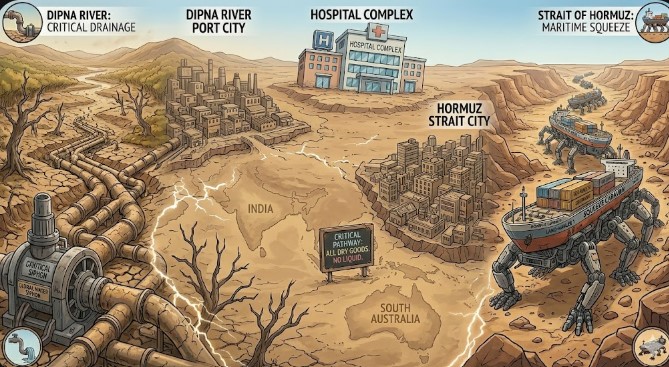
The Arteries of Survival and how Waterway Control Dictates Global Health from the Dnipro to the Strait
04/04/2026
In the modern era, the map of global healthcare is increasingly drawn not by the location of hospitals, but by the flow of water. From the freshwater basins of Eastern Europe to the saltwater chokepoints of the Persian Gulf, the ability to control a waterway has become synonymous with the ability to grant or deny life-saving medical care. As we move deeper into 2026, two disparate geographic points including Zaporizhzhia and Bandar Abbas have emerged as the world’s most critical barometers for this new reality of "hydro-medical" security.
In Zaporizhzhia, the Dnipro River is far more than a scenic backdrop and it is a fundamental clinical utility. For the region’s massive healthcare network, the river provides the cooling necessary for the Zaporizhzhia Power Plant sourced by nucelar energy and the pressurized water required for municipal sanitation systems.
The control of the Dnipro river has created a "sanitation blockade." Frequent disruptions to pumping stations and filtration plants have left major surgical hubs in Zaporizhzhia operating on a knife’s edge. Modern medicine is water-intensive; a single dialysis session requires approximately 120 liters of highly purified water, and sterile processing departments cannot function without consistent hydraulic pressure.
When the river’s flow is contested or infrastructure is compromised, hospitals are forced into a "cramped" existence. Reports from the ground indicate that medical staff are increasingly relying on autonomous modular water treatment units, miniature, containerized plants to keep intensive care units operational. This shift from centralized municipal supply to "islanded" hospital utilities is a direct response to a landscape where the river has been weaponized, transforming a natural resource into a tool of strategic leverage.
While the crisis in Zaporizhzhia is one of local operational survival, the situation at Bandar Abbas is one of global logistical resilience. Bandar Abbas sits at the gateway of the Strait of Hormuz, a maritime chokepoint through which 20% of the world’s petroleum and a significant portion of its pharmaceutical precursors must pass.
In early 2026, maritime instability in the Strait has sent shockwaves through the global medicine cabinet. Bandar Abbas is a primary node for the transit of petrochemical precursors used to manufacture Active Pharmaceutical Ingredients (APIs). When the Strait is "throttled," the impact is felt thousands of miles away in the pharmacies of London, Brisbane, and Mumbai.
The current disruption has created what logistics experts call "stacked constraints." Shipping reliability through the Strait has plummeted, forcing vessels to reroute around the Cape of Good Hope. This adds 10 to 14 days to delivery schedules a delay that is fatal for temperature-sensitive biologics, insulin, and oncology therapies. For a world already struggling with a "cramped" supply of finite resources, the closure or slowing of this waterway is the equivalent of a cardiac arrest in the global pharmaceutical body.
The control of these waterways does more than just delay ships or dry up taps; it erodes the "holistic health" of entire populations. The scarcity mindset triggered by these blockades creates a persistent state of "survival stress."
When a mother in Zaporizhzhia cannot be certain that a hospital has the sterile water needed for a safe delivery, or a diabetic patient in a GCC nation watches the price of imported insulin skyrocket due to maritime surcharges, the result is a systemic spike in collective anxiety. This chronic stress depletes the "human brain power" needed for creative problem-solving, trapping societies in a cycle of managing immediate crises rather than investing in long-term health innovation.
The "wicked problem" of waterway-dependent healthcare requires a fundamental shift in how we view global security. In both Zaporizhzhia and Bandar Abbas, the traditional approach has been one of control which is dominating the resource to gain an advantage.
However, 2026 is seeing the rise of a more regenerative strategy. In the Asia-Pacific and beyond, healthcare leaders are calling for "Blue Corridor" protections, international agreements that treat medical supply lanes and hospital water sources as neutral, protected zones, regardless of the surrounding environment.
Innovation is also playing a role. The emergence of decentralized manufacturing—where APIs are produced in smaller, local "micro-factories" rather than being shipped across the globe is a direct attempt to decouple human health from maritime blockades. In Australia, new partnerships with global pharma leaders are already exploring this model, aiming to turn the "cramped" reality of global shipping into a "flow" of local production. The lessons from Zaporizhzhia and Bandar Abbas are clear and the health of a nation is only as secure as the water that sustains it.
To move past the "Cramped Earth" energy and health paradox, we must stop viewing these waterways as prizes to be hoarded and start seeing them as the shared arteries of a single, global organism. Only by harnessing our collective intelligence to protect these flows can we ensure that the next generation of healthcare is defined by its abundance, not its blockades.
Back
In Zaporizhzhia, the Dnipro River is far more than a scenic backdrop and it is a fundamental clinical utility. For the region’s massive healthcare network, the river provides the cooling necessary for the Zaporizhzhia Power Plant sourced by nucelar energy and the pressurized water required for municipal sanitation systems.
The control of the Dnipro river has created a "sanitation blockade." Frequent disruptions to pumping stations and filtration plants have left major surgical hubs in Zaporizhzhia operating on a knife’s edge. Modern medicine is water-intensive; a single dialysis session requires approximately 120 liters of highly purified water, and sterile processing departments cannot function without consistent hydraulic pressure.
When the river’s flow is contested or infrastructure is compromised, hospitals are forced into a "cramped" existence. Reports from the ground indicate that medical staff are increasingly relying on autonomous modular water treatment units, miniature, containerized plants to keep intensive care units operational. This shift from centralized municipal supply to "islanded" hospital utilities is a direct response to a landscape where the river has been weaponized, transforming a natural resource into a tool of strategic leverage.
While the crisis in Zaporizhzhia is one of local operational survival, the situation at Bandar Abbas is one of global logistical resilience. Bandar Abbas sits at the gateway of the Strait of Hormuz, a maritime chokepoint through which 20% of the world’s petroleum and a significant portion of its pharmaceutical precursors must pass.
In early 2026, maritime instability in the Strait has sent shockwaves through the global medicine cabinet. Bandar Abbas is a primary node for the transit of petrochemical precursors used to manufacture Active Pharmaceutical Ingredients (APIs). When the Strait is "throttled," the impact is felt thousands of miles away in the pharmacies of London, Brisbane, and Mumbai.
The current disruption has created what logistics experts call "stacked constraints." Shipping reliability through the Strait has plummeted, forcing vessels to reroute around the Cape of Good Hope. This adds 10 to 14 days to delivery schedules a delay that is fatal for temperature-sensitive biologics, insulin, and oncology therapies. For a world already struggling with a "cramped" supply of finite resources, the closure or slowing of this waterway is the equivalent of a cardiac arrest in the global pharmaceutical body.
The control of these waterways does more than just delay ships or dry up taps; it erodes the "holistic health" of entire populations. The scarcity mindset triggered by these blockades creates a persistent state of "survival stress."
When a mother in Zaporizhzhia cannot be certain that a hospital has the sterile water needed for a safe delivery, or a diabetic patient in a GCC nation watches the price of imported insulin skyrocket due to maritime surcharges, the result is a systemic spike in collective anxiety. This chronic stress depletes the "human brain power" needed for creative problem-solving, trapping societies in a cycle of managing immediate crises rather than investing in long-term health innovation.
The "wicked problem" of waterway-dependent healthcare requires a fundamental shift in how we view global security. In both Zaporizhzhia and Bandar Abbas, the traditional approach has been one of control which is dominating the resource to gain an advantage.
However, 2026 is seeing the rise of a more regenerative strategy. In the Asia-Pacific and beyond, healthcare leaders are calling for "Blue Corridor" protections, international agreements that treat medical supply lanes and hospital water sources as neutral, protected zones, regardless of the surrounding environment.
Innovation is also playing a role. The emergence of decentralized manufacturing—where APIs are produced in smaller, local "micro-factories" rather than being shipped across the globe is a direct attempt to decouple human health from maritime blockades. In Australia, new partnerships with global pharma leaders are already exploring this model, aiming to turn the "cramped" reality of global shipping into a "flow" of local production. The lessons from Zaporizhzhia and Bandar Abbas are clear and the health of a nation is only as secure as the water that sustains it.
To move past the "Cramped Earth" energy and health paradox, we must stop viewing these waterways as prizes to be hoarded and start seeing them as the shared arteries of a single, global organism. Only by harnessing our collective intelligence to protect these flows can we ensure that the next generation of healthcare is defined by its abundance, not its blockades.
Subscribe to our Newsletter